
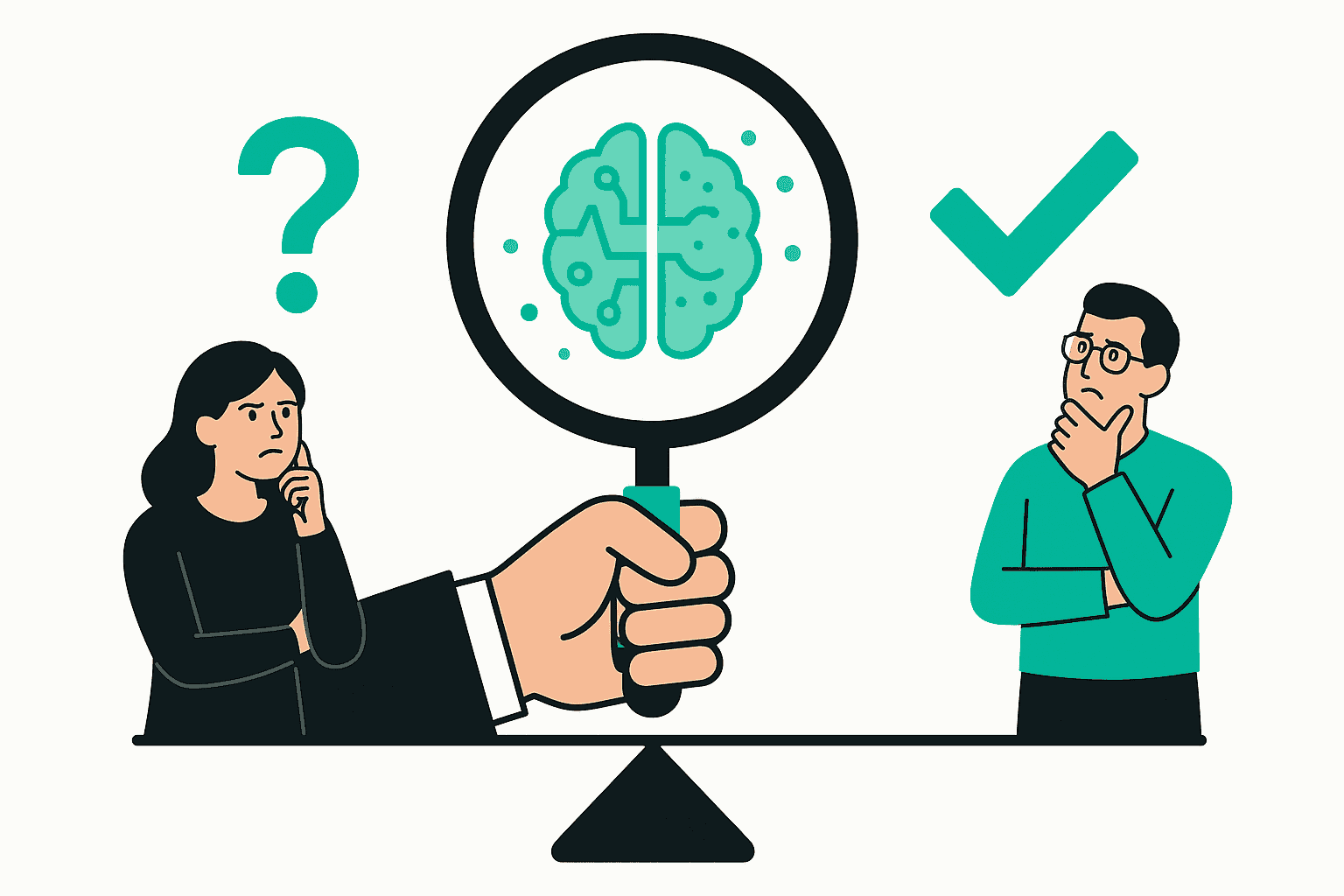
Artificial intelligence can now generate articles, essays, and entire websites at the click of a button. This rapid rise of AI-generated content has sparked an equally fast-growing demand for AI detectors – tools that can tell if content was written by a human or a machine.
Skeptics may call AI detection a passing fad, but the evidence suggests otherwise. From classrooms to newsrooms, and from search rankings to content moderation, AI detectors are increasingly woven into the fabric of digital content governance.
Are AI detectors a fad or a future necessity?
Let’s explore the history, current use cases, challenges, and why these tools are poised to become a long-term staple for content integrity.
The Rise of AI-Generated Content (and Detection Tools)
AI text generation has progressed at breakneck speed in the past few years. OpenAI’s language models, from GPT-2 (2019) to GPT-4 (2023), demonstrated that algorithms can produce remarkably human-like writing.
The public release of ChatGPT in late 2022 brought AI writing into mainstream use, raising alarms about plagiarism, misinformation, and loss of human authenticity. In response, developers and researchers began creating AI detection tools to distinguish human-written text from AI outputs.
For example, when OpenAI released its GPT-2 model in 2019, it also open-sourced a companion GPT-2 output detector – acknowledging that content-based detection of AI text is a “long-term challenge” and achieving high accuracy would require combining AI detectors with metadata and human judgment.
The need for detection became even more urgent by early 2023: a Princeton student, Edward Tian, built the app GPTZero to identify ChatGPT-written essays, garnering 30,000 users in a week. Around the same time, Stanford researchers introduced DetectGPT, an algorithm to tell apart human vs.
AI-generated text with promising accuracy. Even OpenAI itself launched an official AI-written text classifier in 2023 – only to quietly discontinue it months later due to a “low rate of accuracy”.
The takeaway from this brief history is twofold: AI-generated content has exploded in use, and a parallel wave of AI detectors has risen to keep it in check.
What began as niche research projects (e.g. OpenAI’s detector, academic prototypes) quickly evolved into widely available tools like GPTZero, ZeroGPT, and integration of AI checks into plagiarism software.
This trajectory underscores that detection tools were not a one-off craze; they emerged directly in response to real problems introduced by generative AI, suggesting a sustained role rather than a fad.
Why AI Detectors Matter: Use Cases in 2025
Far from being gimmicks, AI content detectors have found practical, high-stakes use cases across multiple domains. Here are some key areas where AI detection is already playing a vital role:
Education and Academia
Perhaps the earliest adopters of AI detectors were teachers and universities concerned with academic honesty. With students now able to have AI draft essays or solve assignments, educators turned to detectors to identify AI-written submissions.
Universities are increasingly relying on AI detectors to ensure students turn in original work and truly develop their own writing and critical thinking skills.
For instance, the popular plagiarism checker Turnitin added AI-writing detection capabilities to its platform in 2023, alerting instructors if part of a student’s paper was AI-generated.
By flagging suspicious essays, detectors help uphold academic integrity and deter would-be cheaters. (Of course, ethical use is crucial – we’ll discuss later how false positives can pose challenges in this context.)
Publishing and Journalism
In media, publishing, and journalism, authenticity of information is paramount. AI text generators can churn out news copy or reports, but if left unchecked this could flood the information ecosystem with auto-generated stories that haven’t been rigorously fact-checked or vetted by humans.
News outlets and content platforms use AI detectors to verify whether articles or submissions were written by a human journalist or an AI.
This helps maintain journalistic integrity and trust. AI can be useful for tasks like drafting summaries, but editors need to know if a piece was AI-written so they can apply extra scrutiny.
Detection tools thus act as a safeguard against misinformation and allow human oversight to remain “in the loop” of content creation.
In short, detectors help ensure that when an article is presented as authored by an expert, it truly reflects human expertise and not just a generative model’s output.
SEO and Content Marketing
Website owners and SEO professionals have a keen interest in AI detectors as well. Google’s stance on AI content has evolved, but it consistently emphasizes “people-first” content that demonstrates experience, expertise, authoritativeness, and trustworthiness (E-E-A-T).
Automatically generated text that is thin or spammy can violate Google’s guidelines and harm a site’s rankings. While Google doesn’t ban all AI-written content, it has systems to detect AI-generated material and uses that information to filter out low-quality pages.
Thus, many content teams run their copy through AI detectors to catch any sections that read as machine-made or template-like, so they can improve them. This is both a quality control measure and a way to avoid potential search ranking penalties.
In practice, integrating AI detection into the content workflow – for example, using an API to scan articles before publication – can help ensure that what gets published meets the authenticity and quality bar for search engines and, more importantly, for readers.
Regulatory Compliance and Business Integrity
Beyond SEO, detectors serve broader compliance and brand integrity needs. Businesses now use AI for drafting emails, marketing copy, even customer support answers. However, companies in regulated industries (finance, healthcare, etc.) must be careful that content meets legal and ethical standards.
AI-generated text may inadvertently produce incorrect or biased statements, so compliance officers may deploy detectors to identify AI-written passages for extra review. Moreover, as legislation catches up (e.g. the EU AI Act and various proposals), we may soon see requirements to label AI-generated content.
In such scenarios, detectors become necessary tools for due diligence, helping organizations verify content origins and ensure nothing slips through that could pose legal risks.
Even for corporate communications and branding, some firms insist on a human touch – AI detectors can enforce that by flagging any copy that was too auto-generated, thus preserving the expected level of professionalism and creative voice.
Across all these use cases, a common thread is trust. Whether it’s a teacher trusting that an essay is a student’s own work, a reader trusting a news piece, or a user trusting a website’s content, AI detectors help maintain that trust by providing transparency.
They act as an “audit trail” for content authenticity. Next, we’ll examine why these tools are becoming more important (not less) as AI models grow more powerful.
Smarter AI Models, Harder Detection
If AI detectors sometimes feel like an arms race, that’s because they are. Each new generation of AI language model is more fluent and “human-sounding” than the last, making the detector’s job increasingly difficult.
For example, OpenAI observed that larger models’ outputs are more difficult to classify as AI-generated, and they expected detection to become more challenging as model size and sophistication increase.
GPT-3 and GPT-4 can produce text with varied vocabulary, tone, and even inject occasional errors or colloquialisms – all tactics that evade simple detection cues like repetitive phrasing.
Compounding the issue, users have learned to game the system. It’s trivially easy to take an AI-generated essay and “humanize” it to avoid detectors, for instance by asking the AI to rewrite in a more casual style or by manually editing a few words.
A senior AI professor noted that it’s an endless cat-and-mouse game: you can prompt ChatGPT to add more randomness or mimic a specific human voice, which “will make [the text] harder [to detect], but it won’t stop it.”.
In fact, an ecosystem of “AI paraphrasers” or “AI humanizers” has already appeared – tools designed to rephrase AI text to look more human and fool the detectors. As detectors improve, so do the evasion techniques, in a cycle reminiscent of antivirus software vs. malware.
Another reason detection is getting harder is the multi-lingual and multi-modal expansion of AI. Today’s detectors are mostly trained on English writing; advanced AI models, however, can generate content in many languages and even create images or audio deepfakes.
This means detectors must broaden their scope (e.g. tools to catch AI-generated images or foreign language text) – a non-trivial pursuit.
Studies have also highlighted that humans themselves struggle to tell apart AI text. In one experiment, people could only guess whether a passage was AI or human with about 50% accuracy – basically random chance.
If even human readers can’t reliably sense the difference as AI improves, the only solution is more sophisticated detection technology under the hood.
In short, the better AI gets at writing, the more necessary AI detectors become. We can’t rely on gut instinct or superficial clues for long; investment in robust detection methods (potentially using AI to detect AI) will have to keep pace with generative AI’s progress.
This escalating challenge indicates that detection tools are not a temporary stopgap – they will be an enduring companion to generative systems, evolving alongside them.
Accuracy Challenges (and Why We Still Need Detection)
It’s important to acknowledge that today’s AI detectors are far from perfect. Current detection algorithms can and do make mistakes, sometimes with high stakes consequences. False positives – flagging a human-written piece as AI-generated – are a serious concern, especially in education.
For instance, in early use of Turnitin’s AI-writing detector, the company found a “higher incidence of false positives” on documents with only a small percentage of AI-written text. In other words, if a student wrote most of their essay but used a bit of AI help, the system might incorrectly flag the whole work.
Turnitin reported adjusting its system (e.g. raising the word count threshold for analysis and marking low-percentage results as “less reliable”) to reduce unwarranted accusations.
Nonetheless, even a tiny false positive rate can scale up to many wrongful flags when thousands of students are involved – one analysis noted that a 1% false positive rate could falsely accuse over 200,000 students in the U.S. in a given year. Such errors carry real harm: stress and anxiety for students, potential academic penalties, and damage to trust.
Bias in detection is another documented issue. Some AI detectors have been found to misclassify writing by non-native English speakers as AI-generated at disproportionate rates. This happens because these tools often correlate “imperfect” or less idiomatic English with the statistical patterns of AI text.
That means a perfectly honest essay by a foreign student might be flagged simply due to writing style, raising serious fairness concerns.
Bias can also affect other groups – reports indicate detectors might be more likely to falsely flag content by Black students or neurodiverse writers, likely due to dialect or usage differences that deviate from the model’s notion of standard text.
These examples underscore that detection technology can inadvertently reinforce biases, which is unacceptable if used punitively.
With such challenges, one might wonder: if detectors can be error-prone, why use them at all? The key is to use them responsibly and in combination with human judgment, rather than abandon them. Detection accuracy is improving, and even now these tools provide valuable signals.
For example, an AI detector that says a document is 90% likely AI-written should prompt a closer human review – not an automatic punishment, but a clue that warrants verification.
The alternative (having no detectors) would mean AI-generated content slips through entirely unchecked, which opens the door to rampant plagiarism, undetected misinformation, and other harms.
Indeed, experts caution against over-reliance on any single detection tool, but in the same breath they warn that we must continue developing better detectors to maintain trust as AI content proliferates.
It’s a delicate balance: we acknowledge detectors’ limitations (and continue to refine them), yet their presence is still “crucial to… build trust” in an AI-permeated content landscape. The answer is not to throw the baby out with the bathwater, but to make the water cleaner.
In practical terms, this means organizations should deploy AI detectors with clear policies: treat their outputs as probabilistic, allow appeals or second checks for anyone accused solely by a detector, and combine automated detection with other evidence (like oral exams for students, or editorial oversight for writers).
When used in this balanced way, detectors remain an essential safety net without becoming a blunt instrument.
The Risks of Undetected AI Content
What’s the worst that could happen if AI-generated material flows undetected and unchecked? In truth, there are significant real-world risks to consider:
Misinformation and Fake News
Bad actors can use AI to generate countless articles, social media posts, or deepfake news stories that look credible. If we lack tools to detect AI origins, misinformation can spread much more easily because it’s cheap to produce at scale.
Imagine waves of fabricated news reports or fake “expert” blogs generated to sway public opinion or financial markets.
Without detectors (or provenance tracking), average readers won’t know what to trust. A flawed or absent detection regime could thus fuel the spread of false or manipulated information, undermining public discourse.
Plagiarism and Academic Dishonesty
Students or researchers could pass off AI-written work as their own, devaluing genuine learning and research. If AI-generated academic papers slip by, it could flood conferences and journals with auto-written content, diluting academic quality.
Undetected AI cheating not only harms the cheater’s education but also erodes the credibility of educational credentials. This is why many educators feel some form of detection is needed as a deterrent – to preserve a level playing field and uphold the meaning of academic work.
Erosion of Creative Industries
In fields like blogging, journalism, marketing, or publishing, if AI ghostwriting is not detected, we might see a surge of low-quality, homogeneous content.
Readers may become disenchanted as they encounter article after article that feels formulaic (an AI can produce 100 mediocre blog posts far faster than a person can write one good piece).
Search engines and readers alike could lose trust in content ecosystems if ghostwritten AI content isn’t kept in check. This decrease in trust affects everyone – legitimate creators struggle to stand out amidst AI-generated noise, and the public grows cynical about whether anything they read is genuine.
Non-compliance and Legal Liabilities
Certain types of content must be human-generated or at least human-verified – for instance, financial disclosures, medical advice, or legal documents – due to regulations or liability concerns. Undetected AI content in these areas could lead to compliance violations or even harm.
Consider an AI generating an incorrect medical guideline that gets published unknowingly: the risk to patients is evident.
If companies cannot detect AI contributions, they may inadvertently violate laws (like copyright if the AI regurgitated training data) or produce content without the legally required human oversight.
Spam and SEO Manipulation
On the internet, spammers can use AI to create hundreds of websites filled with auto-generated text to game SEO or ad revenue. Search engines rely on detecting such behavior to avoid delivering garbage results.
If detection fails, the web could become littered with AI-spam pages, making it harder for users to find trustworthy information. Google explicitly uses AI detection to flag spammy, automatically generated content – a necessary step to keep search results credible.
This illustrates that detectors aren’t just protecting individual interests; they help maintain the overall health of the digital ecosystem by curbing spam proliferation.
In summary, undetected AI content poses threats to truth, fairness, and trust online. The stakes range from individual reputations to societal well-being. AI detectors act as a countermeasure to these risks: not a perfect shield, but certainly better than leaving the floodgates wide open.
Preserving Authenticity and Trust with Detection (E-E-A-T)
One of the strongest arguments that AI detectors are a long-term necessity lies in their role in preserving authenticity and supporting the experience, expertise, authoritativeness, and trustworthiness (E-E-A-T) of digital content.
In an era when anyone can use an AI to generate passable content on virtually any topic, how do we ensure that what we consume online is authentic and credible?
Authenticity here means knowing that content truly represents a human creator’s knowledge or experience, rather than being a generic AI pastiche.
For example, if I read a travel blog, I expect that the author actually visited the place or at least has some personal insight – that’s the “experience” and “expertise” part of E-E-A-T.
AI-generated text, by contrast, has no lived experience; it can only remix what it’s seen in training data. Detectors can help flag content that might be AI-made, prompting an editor or platform to double-check authenticity.
This doesn’t mean all AI content is bad, but when credibility hinges on lived experience or expert opinion, undisclosed AI generation is deceptive. Using detectors to enforce disclosure (or to filter out AI-only pieces in certain contexts) helps maintain honesty with the audience.
Search engines like Google also prioritize content with strong E-E-A-T signals – content that demonstrates first-hand experience, is written by authoritative sources, and is trustworthy.
“Creators should prioritize original, people-first content demonstrating expertise, experience, authoritativeness, and trustworthiness,” Google advises.
While AI can assist in writing, human oversight and originality are crucial to meet these standards. AI detectors serve as tools for publishers and SEO professionals to ensure their content aligns with these quality principles.
If a detector highlights that an article appears heavily AI-written, an editor might decide to inject more human perspective or assign a real expert to rewrite it – thereby boosting the content’s E-E-A-T profile. In this way, detection isn’t about gatekeeping for its own sake; it’s about upholding quality and trust.
Moreover, there’s an element of transparency and trust with your audience. Many reputable sites now disclose when AI was involved in producing content. If you run a site or a journal, using detectors internally can help enforce those disclosure policies (catching any AI use that authors didn’t report).
Readers appreciate knowing the provenance of what they’re reading – it builds trust. On the flip side, if a site gets known for publishing obviously AI-generated fluff, its reputation suffers.
So, detectors indirectly help maintain trust by keeping content creation honest. This aligns with the “Trustworthiness” in E-E-A-T: showing that you value accuracy and authenticity enough to check for AI usage can become a trust signal itself.
In summary, AI detectors help preserve the human element in content, which is key to authenticity and trust. They’re a tool to enforce quality standards (like E-E-A-T) and ensure that Experience and Expertise are genuinely present, not just fabricated by a language model.
In the long run, content platforms that leverage detectors smartly will likely earn more user trust, because they can confidently stand behind the integrity of what they publish.
Evolving Together: The Future of AI Detection
Far from fading away, AI detection technology is poised to advance in lockstep with generative AI. As the cat-and-mouse dynamic continues, we can expect AI detectors to become smarter, more integrated, and more ubiquitous. Here are some developments on the horizon:
- Advanced Detection Techniques: Researchers are exploring methods like AI watermarking – subtly embedding signals in AI-generated text to make it easier to identify. OpenAI has mentioned researching “provenance techniques” to help detect AI content reliably. Future detectors might combine multiple approaches: linguistic analysis, cryptographic watermarks, and cross-model verification. For instance, a detector might use its own AI model to cross-check suspicious text against known AI outputs. The goal is to stay one step ahead of increasingly human-like AI generators.
- Real-Time and Built-In Detectors: We’ll likely see detectors baked into writing and publishing platforms. Imagine a word processor that, as you paste a paragraph, gives a gentle alert “This section appears AI-written” if it detects something. Content management systems (CMS) might have plugins that automatically scan and flag AI content before anything goes live. In fact, experts predict real-time detection integrated into editors and CMS as a next step. This would normalize the use of detectors – they could become as common as spell-check or plagiarism checkers in digital content workflows.
- Broader Media Detection: Thus far we’ve focused on text, but AI is generating images, video, and audio too. The future necessity of detection extends to these formats: tools to detect deepfake images and videos, AI-generated voices, etc. Tech companies are already working on image watermarks (e.g. Google’s SynthID for AI-generated images) and deepfake detectors. We might see a unified dashboard where content moderators can scan any uploaded media – text, image, or video – for signs of AI generation. This will be crucial for platforms like social media to combat AI-driven misinformation and fraud (think AI voice scams or fake viral videos).
- Collaboration with AI Governance: As government and industry groups craft guidelines for responsible AI, detection will be a key piece of the puzzle. We may see regulations that require AI-generated content to be labeled or require companies to have “reasonable measures” to identify AI content. In such cases, detectors become not just optional tools but mandated safeguards. Already, there is broad recognition that “continued advancement of AI will require parallel progress in detection methods to ensure fairness, accountability, and transparency”. In other words, society will treat detectors as critical infrastructure to keep AI usage accountable.
- User Empowerment: In the future, even end-users might have access to detection at their fingertips (e.g. a browser plugin that can tell you if a webpage or a quote on social media was AI-generated). This could empower readers to verify content authenticity on the fly. If detectors become reliable enough, they could restore some power to individuals to navigate an AI-saturated information space – like a truth filter for the modern age.
The arms race will no doubt continue, but it’s clear that AI detectors will evolve rather than disappear. Each leap in generative AI spurs a leap in detection techniques.
Far from being a fleeting tech fad, they will be an enduring feature of the AI era – the yin to AI’s yang – ensuring we can harness AI’s benefits without swallowing its outputs blindly.
Integrating AI Detectors into Content Workflows
Given all the above, savvy content creators and organizations are starting to view AI detectors as a strategic necessity in their workflows. The mindset is shifting from “Should we use an AI detector?” to “How do we best use AI detectors as part of our process?”. Here are some strategic ways detectors are being integrated:
Editorial Review Process
Many online publishers now incorporate an AI check along with their standard editorial checks. For example, an editor might run a freelance writer’s article through a detector tool.
If the result indicates a high likelihood of AI use, the editor can follow up – perhaps by asking the writer for clarification or making sure the content is thoroughly edited for originality.
This doesn’t mean the article is rejected outright, but the detector acts as a triage system to catch potential issues (much like a plagiarism scan would). The result is that publishers ensure higher authenticity in the content they put out, protecting their brand and audience trust.
SEO Content Strategy
Agencies producing SEO-oriented content have learned that quantity means nothing without quality (and legitimacy). They use AI detectors to audit content at scale.
For instance, if a site has 500 product descriptions written by various contractors, an automated detector can quickly flag which ones look AI-generated so the SEO team can revise them.
This saves time and potentially saves the site from search ranking issues. Essentially, detectors can be used to enforce content standards across large volumes of text – a task that would be impossible to do manually for dozens or hundreds of pages.
Moderation and UGC (User-Generated Content)
Websites and forums that allow users to post content are eyeing detectors to help moderate AI-generated posts. Consider a scenario like Wikipedia or an academic Q&A forum: if bots start posting AI-written answers en masse, it undermines the community.
An AI detector could assist moderators by flagging posts that are likely AI-written so they can review or label them appropriately. This way, community guidelines (which often require original thought or disclosure of sources) are upheld.
Reddit, for example, has had moderators experimenting with detecting AI-written comments to maintain discussion quality.
Corporate and Legal Workflows
Businesses can integrate detectors into their content approval pipelines. Say a financial firm wants to ensure all client reports have a human expert’s sign-off – they might use a detector on drafts and require human revision for any sections flagged as AI.
Legal teams might use detectors to verify that sensitive documents (contracts, policies) were not generated by AI without oversight, as a quality assurance step.
Some companies are even training in-house detectors fine-tuned to their domain, to better catch AI-generated text in specialized documents (like code, logs, or technical writing) that general detectors might miss. All of this adds up to embedding AI awareness into the workflow rather than treating it as an afterthought.
APIs and Automation
On the tech side, many detector providers offer APIs, allowing seamless integration. This means a content management system or a custom application can automatically call an AI detection service whenever new content is submitted.
The response could trigger certain actions – e.g. content tagged as “AI likely” might be held for manual review, whereas “human likely” content flows through. By automating detectors in this way, organizations can scale their content oversight efficiently. Developers are essentially plugging detectors into the content pipeline so that it becomes a routine quality check.
The strategic value here is clear: integrating detectors helps catch problems early, maintain standards, and send a message (internally and externally) that content integrity matters. Organizations that incorporate these tools are proactively adapting to the AI age, rather than playing catch-up after the fact.
Over time, this could even become a competitive differentiator – users and partners will gravitate towards platforms known for trustworthy, authentic content. In contrast, those who ignore detection might face scandals or credibility crises down the line when AI-generated mistakes or fraud come to light.
Conclusion: AI Detectors – A Long-Term Pillar of Content Integrity
Considering the rapid advancement of AI content generation and the corresponding risks and needs we’ve discussed, it’s evident that AI detectors are not just a passing fad, but a future necessity.
They have already entrenched themselves in critical domains to uphold honesty, quality, and trust. As generative AI continues to evolve, detection tools will likewise become more essential and sophisticated.
Rather than viewing this as a war of humans vs. machines, it’s more constructive to see detectors as enablers of responsible AI use.
They let us enjoy the efficiencies of AI-generated content while keeping us alert to its pitfalls. In the long run, the presence of robust AI detection will help ensure a healthy balance: AI becomes a valuable assistant, and human creativity and authenticity remain front and center.
So, whether you’re a content creator refining your blog posts, an educator safeguarding academic integrity, a business protecting your brand voice, or just an everyday reader of the web, remember that content integrity matters.
AI detectors are here to protect that integrity for the long haul, acting as guardians of authenticity in our digital world.
Whether you’re writing for search engines, classrooms, or readers — content integrity matters. Run your text through our free, multilingual AI detector in seconds — no sign-up needed.