
The rise of AI writing tools (from GPT-4 to other content generators) has left many content creators and SEO professionals wondering: Does Google penalize AI-generated content? In other words, if you use AI to help write articles or blog posts, will Google’s algorithm automatically demote your site? This is a crucial question for anyone producing content in 2025, given how common AI assistance has become.
The short answer is no – Google does not explicitly penalize content just for being written by AI. What really matters is content quality and intent, not the tool used to create it. In this article, we’ll break down Google’s official stance on AI content, explain relevant guidelines (like the Helpful Content system, E-E-A-T principles, and spam policies), and share how you can ensure your AI-assisted content meets Google’s standards.
We’ll also debunk the misconception that “AI = penalty” and flag why quality and user value are far more important. Finally, we’ll touch on real-world examples of AI content in SEO and offer tips for using AI without risking your rankings.
Google’s Stance: Quality Over Who Writes the Content
Google’s own guidance makes it clear that how content is produced is less important than its quality. In early 2023, Google’s Search Central Blog stated that their ranking systems aim to reward original, high-quality content that demonstrates E-E-A-T (Experience, Expertise, Authoritativeness, Trustworthiness), “rather than how the content is produced”.
In other words, an article written by a human and one generated by AI are evaluated by the same standards: how helpful, trustworthy, and relevant is it? Google cares about what the content delivers to users, not whether it was typed by a person or AI.
Crucially, Google has not banned AI-written content. In fact, Google representatives have explicitly said that “appropriate use of AI or automation is not against our guidelines.” The caveat is that it must not be used to manipulate search rankings.
What does that mean? Basically, using AI to mass-produce low-quality, keyword-stuffed text solely to game the algorithm is considered spam. But using AI as a tool to create useful, original content is perfectly acceptable.
Google even updated its Helpful Content criteria in 2023 to remove the phrase “written by people,” underscoring that content can be AI-generated as long as it is intended for people and adds value. The focus is on content created for people (to inform or help users), rather than just for search engines.
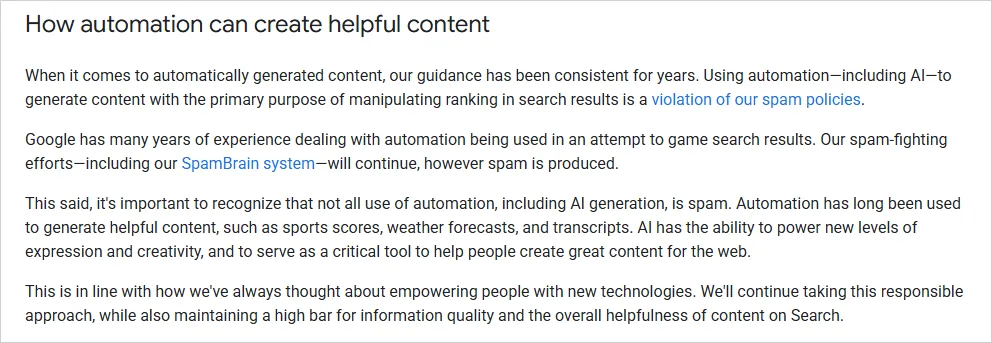
Google’s own guidelines emphasize that using AI with the primary purpose of manipulating rankings violates spam policies, but also note that not all automation is spam if it produces helpful content. In short, AI is a tool – it’s how you use it that counts.
In the past, there was some confusion in the SEO community. Early statements (like one from a Google rep in 2022) suggested AI-generated text might be viewed as “automatically generated” spam, sparking fears of blanket penalties.
However, by late 2022 Google clarified that the real issue isn’t automation itself, but the intent and quality behind it. If content is created primarily to trick search rankings (with little regard for users), that’s a problem – whether it’s written by AI or by a human.
On the other hand, if AI helps you create useful, people-first content, Google has no quarrel with that. As one Google Search Liaison put it, Google’s goal is to show the most relevant and helpful content, so if you can achieve that with AI, then go for it.
Google’s Guidelines: Helpful Content, E-E-A-T, and Spam Policies
Let’s break down the key Google guidelines that relate to AI content:
“Helpful Content” and People-First Approach
Google’s Helpful Content System (launched in 2022) is all about ensuring content is created for people first, not just for search engines.
This guideline doesn’t forbid AI-written material – instead, it asks: is your content genuinely helpful to readers? Initially, Google’s documentation phrased this as content “written by people, for people,” which many interpreted as anti-AI.
But in a September 2023 update, Google removed the words “written by people” to make the point that it’s the “for people” part that matters. Whether a human or an AI writes the text is secondary to whether the content meets a real user need.
To comply with people-first guidance, always aim to answer the user’s query fully, provide original value or insights, and ensure a satisfying reader experience. If an AI helps you do that, great – just avoid the trap of generating fluff that might rank for a keyword but fails to educate or help the reader.
Google’s helpful content guidelines even suggest asking yourself questions like, “Will someone reading this feel they’ve learned enough about the topic?” or “Does my content leave the reader satisfied?” – a reminder that quality trumps quantity or gimmicks.
E-E-A-T: Experience, Expertise, Authoritativeness, Trust
Often discussed in SEO, E-E-A-T is a set of qualities Google looks for in content and websites. It stands for Experience, Expertise, Authoritativeness, and Trustworthiness. These principles apply to all content, AI-generated or not.
Your content should demonstrate first-hand experience or depth of knowledge on the topic, come from an expert source (or at least be reviewed by one), establish authority (for instance, citing reliable sources or showcasing credentials), and build trust with accuracy and transparency.
Google’s algorithms favor content that exhibits E-E-A-T because it’s more likely to be reliable and helpful. In the context of AI content, you need to make sure that using AI doesn’t dilute these qualities. For example, if you use AI to draft an article, have a human with expertise review and fact-check it.
Add insights or personal experience that an AI might miss. Ensure the tone and facts align with your site’s authoritative voice. Google has said its systems reward content that demonstrates E-E-A-T regardless of how it’s produced.
So an AI-written article that is well-researched, accurate, and valuable can still rank well, while a human-written article that’s thin or misleading will not. The takeaway is to infuse any AI-assisted content with genuine expertise and trust signals – this might mean involving human editors or explicitly stating the author’s credentials.
(Google also advises being transparent about who and how content is created when appropriate. For instance, if readers would reasonably wonder “who wrote this?”, include a byline. If AI was heavily used, some sites choose to mention that in an author note or disclaimer, though it’s not mandatory.)
Spam Policies: Don’t Use AI to Spam the Web
Google’s Webmaster Spam Policies provide a clear warning: content generated primarily to manipulate search rankings is against the rules. This includes content that is mass-produced with little effort or originality (often the kind people churn out with automated tools just to target many keywords).
Google calls this “scaled content abuse”, and it can involve AI or any automation. For example, using a generative AI tool to pump out dozens of low-value pages is a spammy practice that Google’s algorithms (and manual reviewers) are on the lookout for.
In fact, one explicit example Google gives is “using generative AI tools to generate many pages without adding value for users” – that would violate their spam policy on scaled content.
This doesn’t mean you can’t have a lot of AI content; it means you can’t have a lot of garbage AI content. If each page is essentially saying nothing new, or just stitching together content from other sites, you’re in dangerous territory.
Google’s spam-fighting systems (like SpamBrain) are trained to detect patterns of low-quality, “no value” pages, whether human or AI-made. And yes, Google has taken action on websites that crossed this line.
In recent spam update rollouts, some sites that flooded the web with AI-generated junk saw their pages deindexed or hit with manual penalties. On the flip side, sites that use AI responsibly (adding value and human oversight) have not faced these issues.
Bottom line: Don’t use AI as a cheap trick to avoid doing the work. Use it to enhance your work. If your AI content is repetitive, nonsensical, or solely aimed at catching Google’s eye (rather than serving readers), then it’s as good as spam and will be treated as such. Always add original value and ensure the content is polished – AI can draft, but you should craft.
How to Ensure Your AI Content Meets Google’s Quality Standards
If you choose to leverage AI in your content creation process, here are some best practices to stay on Google’s good side:
- Keep it People-First: Before hitting “publish,” ask if the content genuinely helps your intended audience. Make sure it addresses the user’s query or need better than the top search results. Avoid creating content just to rank – every article should have a purpose beyond attracting clicks (educate, inform, solve a problem, etc.). This aligns with Google’s people-first content philosophy (think back to the Helpful Content guidelines). If the sole reason for your content is “because I want traffic for this keyword,” take a step back and refocus on user intent and value.
- Edit and Improve AI Drafts: Human editing is essential when using AI. Treat the AI’s output as a first draft. You (or someone on your team) should review every piece for accuracy, clarity, and quality. AI models can produce incorrect facts or awkward phrasing, so fact-check and smooth out the language. Add missing details that an expert or a seasoned writer would include. The goal is to ensure the final content doesn’t feel automated – it should read naturally and be error-free. This also helps with E-E-A-T, since an expert can inject experience or insights that lend authority to the content.
- Demonstrate E-E-A-T in AI-Assisted Content: Make sure the content still carries experience and expertise. For example, if you’re writing about a medical topic, have it reviewed by a medical professional and mention that reviewer’s name or credentials. If you’re using AI to draft a product review, include your personal experience with the product in the final article. Cite credible sources for important facts or statistics (just as you normally would). These practices show Google (and readers) that the content is trustworthy. AI can sometimes generate content that sounds plausible but is actually baseless – counteract that by backing up assertions with evidence and adding a human touch of authenticity.
- Avoid Mass-Producing Mediocre Content: It can be tempting to let the AI crank out 100 articles on 100 different keywords in a day. But remember, Google’s spam algorithms target “unoriginal content created at scale”. It’s much safer to publish fewer, high-quality AI-assisted pieces than to flood your site with lots of thin content. Quality control is key. If you won’t have time to polish each piece, don’t publish it. Additionally, consider spacing out your content releases; a sudden surge of hundreds of new pages that lack depth could raise red flags.
- Provide Transparency (When Appropriate): While not strictly required, being transparent can help build trust. If it makes sense for your audience, you might disclose that AI was used in creating the content – especially in niches where authenticity is critical. For instance, some sites have notes like “This article was written with the help of an AI assistant and thoroughly edited by our editorial team.” Google’s guidelines suggest adding disclosures or bylines if users would expect to know how the content was made. At the very least, always have an author or editor name on articles (avoid listing “AI” as the author, which Google advises against). An author byline signals accountability, which can enhance trust.
Debunking the “AI Content = Penalty” Myth
Despite Google’s communications, a lingering myth in the SEO world is that any AI-generated content will incur a penalty. Let’s set the record straight: there is no automatic penalty just because AI wrote the text. Google’s algorithms do not have a bias against AI – they have a bias against low-quality content.
This myth likely persists due to historical apprehensions and anecdotes of AI misuse. As mentioned, in 2022 some Google officials equated AI content with the kind of auto-generated gibberish that violates guidelines.
This created a scare that Google would “secretly” start downgrading AI-written posts. However, Google’s subsequent updates and studies of search results have shown that this isn’t the case when quality is maintained.
In fact, Google’s own Search Liaison (Danny Sullivan) has repeatedly affirmed that “Google doesn’t care who or what writes your content, as long as it’s helpful” (paraphrasing their guidance).
To further drive a nail in this myth’s coffin, a recent analysis provides real-world evidence: Ahrefs (a respected SEO tool provider) studied 600,000 search results pages in mid-2025 and found no correlation between the presence of AI content and lower rankings.
Over 86 in 100 of the high-ranking pages in that study contained at least some AI-generated content, indicating that AI assistance is very common among top-performing content.
The study concluded that Google neither rewards nor punishes AI content outright. In other words, pages didn’t rank poorly just because they had AI text, and having human-only text didn’t give a magical boost.
What mattered was how useful the pages were to users. This data should reassure content creators: Google is not automatically flagging or throttling AI material. The search algorithm is essentially “AI-agnostic” – it focuses on relevance and quality signals.
AI Content in Action: SEO Wins and Fails
To illustrate how Google treats AI content, let’s look at two scenarios:
- When AI Content Goes Wrong: A digital marketing agency tested publishing an article generated entirely by AI (with minimal editing) on their site, targeting a specific keyword. The content read a bit generic and didn’t offer anything beyond what was already online. During a subsequent Google spam update, that AI-generated page was de-indexed (removed from Google’s results) for being low quality. Realizing the issue, the team rewrote the article with a human touch – adding depth and polishing the writing – and re-published it. Within hours, Google reindexed the page and it even started ranking in the top 10 results. This example shows that the original AI content wasn’t penalized because it was AI, but because it was poor content. As soon as the quality standard was met, Google had no issue ranking it. Similarly, there have been reports of entire websites getting manual penalties due to spammy AI-generated pages – these tend to be sites that pumped out tons of AI content rapidly without regard for quality or originality. The lesson is clear: misuse of AI can hurt you, but only in the same way any bad SEO practice would.
- When AI Content Works Well: On the other hand, many publishers are successfully using AI as a writing aid and seeing great results in SEO. For instance, some large websites use AI to generate drafts of articles which are then reviewed by editors. This lets them produce content faster without sacrificing quality. A lot of everyday content on the web in 2025 has AI fingerprints on it – from news blurbs to product descriptions – and yet these pages rank just fine. The Ahrefs study mentioned earlier is a testament: a huge majority of top-ranked pages had some AI-crafted sentences or sections. Even Google’s own products (like certain search result snippets or translations) involve AI generation. The key is that in these successful cases, the AI content is deployed thoughtfully. It’s part of a workflow that includes human creativity, editorial oversight, and a focus on unique value. A well-known example is how some finance and tech sites experimented with AI-written explanatory articles: when done carefully, readers often couldn’t tell a difference, and the content performed well in search. The bottom line is that AI can be a powerful ally for content creation, so long as you maintain high editorial standards.
Conclusion: Focus on Quality and Intent, Not the AI Tool
At the end of the day, **Google is not interested in waging war against AI-generated content – it’s waging war against low-quality content. If your content is helpful, trustworthy, and satisfies the user, it stands a good chance to rank whether it was drafted by a human, an AI, or a bit of both.
There’s no inherent “Google penalty” for AI content. The so-called penalties and ranking drops happen when content creators use AI (or any method) to churn out pages that offer little to no value to users.
So, does Google penalize AI content? Not simply for being AI. Google penalizes spam, duplicative fluff, and misleading information – the same things it’s always penalized. Your goal as a content creator should be to meet Google’s quality standards regardless of the tools you use.
Embrace AI as a writing assistant if it makes you more efficient, but always put yourself in the shoes of your audience and ask, “Is this actually good content?” If you can confidently answer yes, you don’t need to fear an “AI penalty.”
Finally, to ensure your content hits the mark, consider running it through quality checks. You can also test your content using our free AI detector to see whether it shows a strong AI-writing signal. The current validation is strongest for English text of 100 words or more; other languages have not been validated for the current detector. It is free to use with no login required. Processing time varies with text length and server load.
This can give you insight into whether your text reads as overly “AI-like” and might need a bit more human touch. Remember, though, that even if a detector finds AI traces, Google’s concern is what value the content provides. Use such tools as a guide, not an ultimate judge.
In summary, write for users, edit with care, and don’t abuse automation. Do that, and you can safely harness AI in your content strategy without living in fear of Google.
As Google itself advises: “If you see AI as an inexpensive, easy way to game search rankings, then no [don’t use it]. If you see AI as an essential way to help produce content that is helpful and original, it might be useful to consider.” Happy content creating!
What Google’s guidance actually says
- Google does not ban AI use as a category — it rewards helpful, original, people-first content and acts against spam.
- Scaled content abuse can involve AI, human, or combined methods; the concern is the intent to manipulate rankings, not the tool used.
- The former Helpful Content system became part of Google’s core ranking systems in March 2024; it is no longer a separate system.
- E-E-A-T (Experience, Expertise, Authoritativeness, Trust) is a concept in Google’s rater guidelines, not a single ranking factor.
- An AI-detector result is not a Google ranking signal and does not indicate whether content will rank.
Primary sources
- Google Search’s guidance about AI-generated content
- Google Search spam policies
- A guide to Google Search ranking systems
- SEO Starter Guide
Last verified: July 13, 2026.