


What an AI detector actually measures
An AI detector does not recognise an author. It measures the surface of a passage — how vocabulary, sentence length, punctuation and structure are distributed across it — and compares that shape against what a trained classifier learned from large collections of human and machine writing. What comes back is one number for the whole passage: an AI-writing signal score from 0 to 100, and the band that number falls into.
A high score says the writing looks statistically like the machine-written text the system was trained on. It does not say who typed it. Two passages can score alike for opposite reasons: one because a language model produced it, another because a person wrote to a taught template in a narrow register. Nothing in the measurement separates those two cases. That is why every result here arrives with a band, a Score stability range and the measured false-flag rate for that length of text, instead of as a number on its own.
It also follows that editing moves the reading. Rewrite an opening, split long sentences, or put a draft through another round of revision, and the score shifts, because the surface has shifted. The measurement describes the text in front of it. It is not a record of how that text came to exist, and it is not proof of anything about the person who wrote it.
One sealed test, opened once, with both misses published
Most detectors publish a single accuracy headline and no denominator. This one publishes the whole run that produced its numbers.
The thresholds were fixed and written to a file before any measurement took place. The test set was built without being inspected, scored exactly once, and then retired, so no number here was chosen after someone saw how it would look. Six release targets had been declared in advance. Four were met and two were not, and the two that were missed are printed on this site in the same type as the four that passed:
- About 1.7 in 1,000 human texts of 150 words or more drew a wrong AI signal — 4 of 2,343.
- About 2.4 in 100 human texts of 100 to 149 words drew one. The target for that band was 2 in 100, so this was a miss — 14 of 586.
- The hardest single source of human writing in the set, software bug reports, ran at about 4.8 in 100 against a target of 3 in 100. That was the second miss — 11 of 229.
- About 55 in 100 texts from the tested current models drew a strong AI-writing signal — 221 of 400.
- About 42 in 100 texts from a model lineage the system had never seen in training drew one — 251 of 602.
- About 8 in 100 human texts landed in the middle band, Uncertain, rather than at either edge — 245 of 2,929.
Rather than adjust the system against a test it had already seen, the publisher released it with both misses disclosed. A threshold re-tuned after the fact stops being a measurement of anything. Raw counts, intervals for every source of human writing, and the release decision in full are on the evidence page.
How to check a text, step by step
Give it at least 100 words of English. Below 100 words the tool declines rather than guessing. English is the only language it has been tested on; other languages are accepted, but nothing about those results has been checked, so treat them as unmeasured.
Prefer the longest passage you have. Length is the one thing you control that changes the answer most. Short human writing is easy to misread, so short passages are held to a stricter bar and still misfire more often: about 2.4 in 100 at 100 to 149 words, against about 1.7 in 1,000 at 150 words and above. At 600 words and above, no human text in the sealed set was wrongly flagged at all — 0 of 916. If you have 500 words available, do not check 120.
Read the band before the number. The three bands — Likely human-written, Uncertain and Likely AI-written — are decided by the frozen thresholds on the internal signal, not by the number on the dial. The displayed 0 to 100 score is a fixed mapping of that signal, shown so you can see how far the passage sits from an edge. It never changes the band.
Read the Score stability range as a width. It shows how much the mapping moves when the sources behind it are resampled. A wide range means the number is loosely pinned for text like yours. It is not a margin of error around a true value, and it says nothing about who wrote the passage.
Read the Patterns observed in this text. They describe features the system noticed in the passage and nothing more. They are a reading aid, not a list of accusations, and no sentence is judged on its own.
Who this is for
Teachers reviewing student work. A score is a reason to open a conversation, never a finding. The measured false-flag rate is small, but it is not zero, and it is worst on exactly the writing a school produces most: short, structured, taught-to-a-template answers, often from students working in a second language. Use a result to decide whether to ask a student about their process, their drafts and their sources. Do not use it as evidence in a decision about that student.
Editors and site owners reviewing writers’ drafts. This is the use the tool fits best, because you can act on a signal without accusing anyone: ask for the draft history, ask about the research, ask for a rewrite. Tell your writers that you check, and check every piece rather than only the ones that feel off — a policy applied unevenly is how a small error rate turns into an unfair outcome for one writer.
Writers checking their own work. Self-checking is the one case with no consent problem and nothing at stake. If your own writing lands in Uncertain or above, that is worth knowing before an editor sees it. It usually means the passage is running on generic phrasing, which is a fair thing to fix whoever wrote it.
Reading a result responsibly
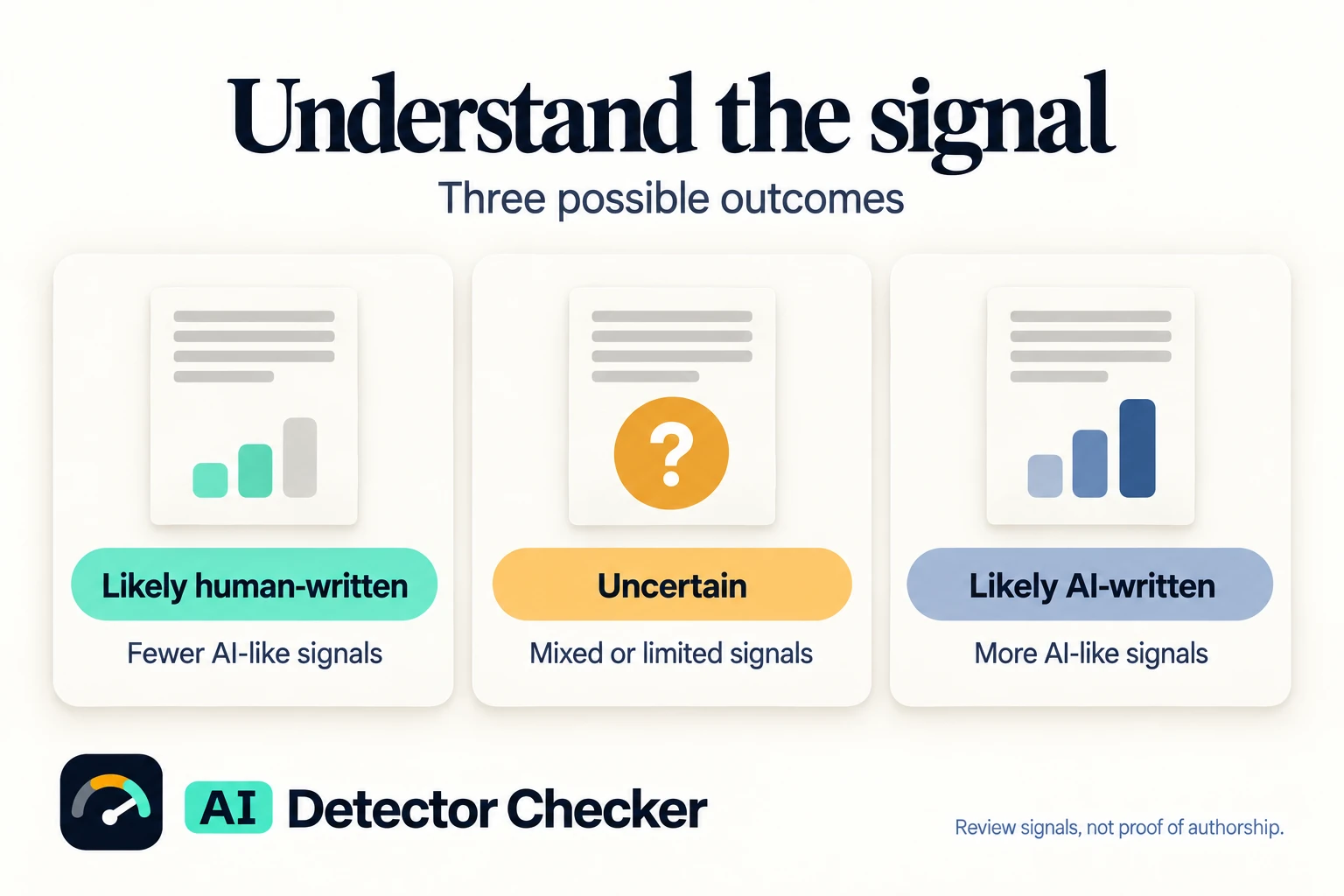
Likely AI-written means the passage sits above the frozen threshold for its length band. It is a strong review signal and it is where the tool earns its keep, but the false-flag rate for the length you checked is printed on the card for a reason. Treat it as the start of a review, not the end of one.
Uncertain is a real answer, not a failure. It says the passage sits between the two edges, and it is common: about 8 in 100 of the human texts in the sealed test landed there. A longer sample from the same writer, if one exists, is the most useful next step.
Likely human-written is the weakest of the three. The system misses a great deal of machine-written text — a little under half of the texts from the tested current models drew no strong signal at all — so a low score is not evidence that a person wrote something. It means only that this passage did not look machine-written to this system.
Whatever the band, one check is never enough for a decision about a person. Run a second passage by the same writer. Look at drafts, revision history, notes and sources. Ask the writer to talk about the material. Those are the things that actually speak to authorship; a score is one input beside them, and on its own it is not proof.
Where this detector fails
- Short text. The 100 to 149 word band is the weakest, at about 2.4 in 100 human texts wrongly flagged, and it is the band that missed its release target.
- Formal and formulaic human writing. Technical writing was the hardest human source in the sealed test: software bug reports ran at about 4.8 in 100. Procedural, structured and boilerplate-heavy prose behaves the same way.
- Non-native English. Writing produced in a second language tends toward plainer vocabulary and more regular sentence construction, which is the shape this system reads as machine-like. The risk for that group is higher than the pooled figure suggests.
- Edited or paraphrased machine text. A pass of human editing moves the surface and the signal falls with it. Missing that text is the most common way the tool is wrong.
- Anything that is not English. Not supported, not tested, not measured — see language support.
AI detector or plagiarism checker?
They answer different questions. A plagiarism checker matches your text against an index of existing documents and reports the overlap it finds, with a source it can point at: a document, a URL, a matched passage. An AI detector matches nothing. It measures the statistical shape of the writing and returns a signal strength with no source to show you.
That difference decides which one to reach for. If the question is whether a passage was copied from somewhere, only a plagiarism checker can answer it, and its answer comes with a citation you can check. If the question is whether a passage reads like machine-written text, a detector gives a signal and no citation, which is exactly why the result is never enough on its own. Neither tool establishes authorship, and running both does not add up to proof. The full comparison is in AI detection versus plagiarism checkers.
Guides on this site
The model guides explain what ChatGPT, Claude, Gemini, DeepSeek and Microsoft Copilot writing tends to look like and how to review it. The detector does not identify which model produced a text, and none of those guides claims otherwise.
By content type, essays, research papers and business reports each have a full guide, and the content-type hub covers nine more in short form.
For the mechanism and the numbers behind it: how a check works, the methodology with the frozen thresholds by length band, training and validation, and the evidence page. If a result surprised you, start with understanding results or what to do if your text is flagged.