
Model guide · reviewed 5 September 2026
ChatGPT Detector
The tool below is the same detector as on the homepage.
English · 100+ wordsengine v3
Paste text to check
V3 uses the same trained core as V2 with new length-based thresholds and a 0-100 display map. How it works →
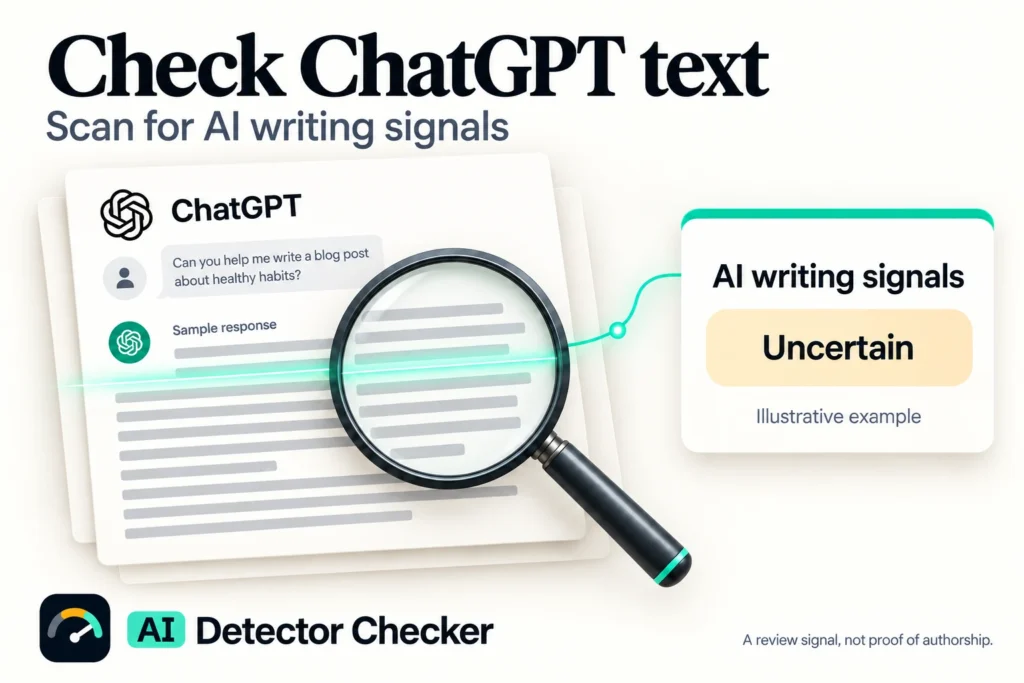
What the evidence shows
In the sealed test, 221 of 400 texts from gpt-5.6-terra and gpt-5.6-sol (OpenAI, current) received a strong AI-writing signal (about 55 in 100). Human text from unseen sources received a wrong AI signal about 2 in every 1,000 times at 150 words or more. The detector never identifies which model wrote a text.
SamplenStrong signalWilson interval
gpt-5.6-terra and gpt-5.6-sol (OpenAI, current)40055 in 10050–60 in 100
Human text, unseen sources, 150+ words2,3432 in 1,0000.7–4.4 in 1,000
Earlier engines were benchmarked on small historical GPT-3.5 and GPT-4 samples. Those numbers describe releases that have been retired, so they are not repeated here; they are kept only in the archive on the evidence page. See the engine history →
Important: The tool does not identify the source model. Model version, prompt, settings, language, task, and human editing can make outputs from different systems overlap substantially.
Looking for a ChatGPT detector or ChatGPT AI checker? AI Detector Checker reviews a meaningful passage for general AI-like writing signals. It returns a 0-100 AI-writing signal score with a score stability range and one of three bands (Likely human-written, Uncertain, or Likely AI-written) for English text of at least 100 words. It cannot confirm that ChatGPT wrote the text or identify a GPT model or version.
Can a ChatGPT Detector Tell Whether ChatGPT Wrote a Text?
Short answer: no. Text does not normally contain a reliable label naming the account, product, model, prompt, or person that produced it. Human writing can overlap with AI output, and different AI systems can produce similar language. Prompt instructions, task, language, length, translation, and editing can all change the result.
- It can: return a 0-100 AI-writing signal score with one of three bands — Likely human-written, Uncertain or Likely AI-written — for review.
- It can: tell you when a passage is too short to assess (fewer than 100 words).
- It cannot: prove that ChatGPT or another AI system wrote the passage.
- It cannot: identify a GPT version, measure plagiarism, or judge factual quality.
What Is a ChatGPT Detector?
The phrase ChatGPT detector usually describes a tool used to review text that may have been generated or assisted by ChatGPT. AI Detector Checker does not perform ChatGPT authorship attribution. Its document-level classifier measures general AI-writing signals, so it can be used when the suspected source is ChatGPT, another model, or unknown.
This distinction protects against a common mistake: treating polished structure, a neutral tone, or predictable phrasing as a unique ChatGPT fingerprint. Those features can occur in human writing and in output from many systems. No checklist of writing habits can establish the source model by itself.
Why Text Alone Cannot Reliably Identify ChatGPT
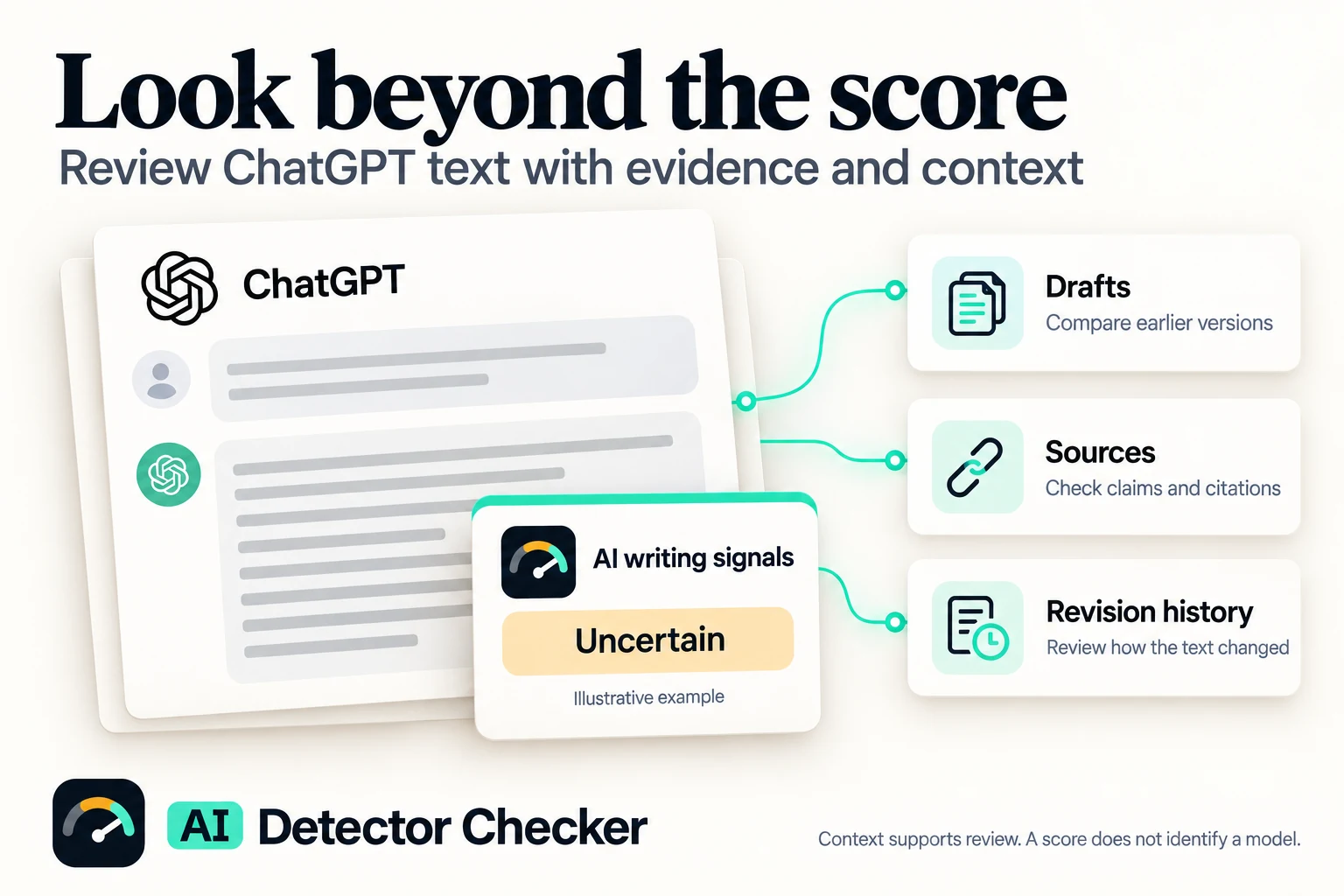
A detector analyzes the submitted words. It does not see the author’s ChatGPT account, conversation, prompt, hidden system instructions, model selector, or revision history. Without that provenance, the output is a language-pattern assessment rather than source verification.
- One system can produce many styles. A prompt can request a short email, poem, technical explanation, table, or informal conversation.
- Different systems can overlap. ChatGPT, other AI tools, templates, and careful human writers can produce similarly structured language.
- Editing changes the evidence. Deleting, adding, translating, or reorganizing text can change a detector result in either direction.
- Short text contains fewer patterns. A headline or isolated sentence provides less evidence than a coherent multi-paragraph passage.
- Genre matters. Formal, academic, technical, legal, and policy writing may be regular and impersonal even when written entirely by a human.
How to Review Text That May Have Used ChatGPT
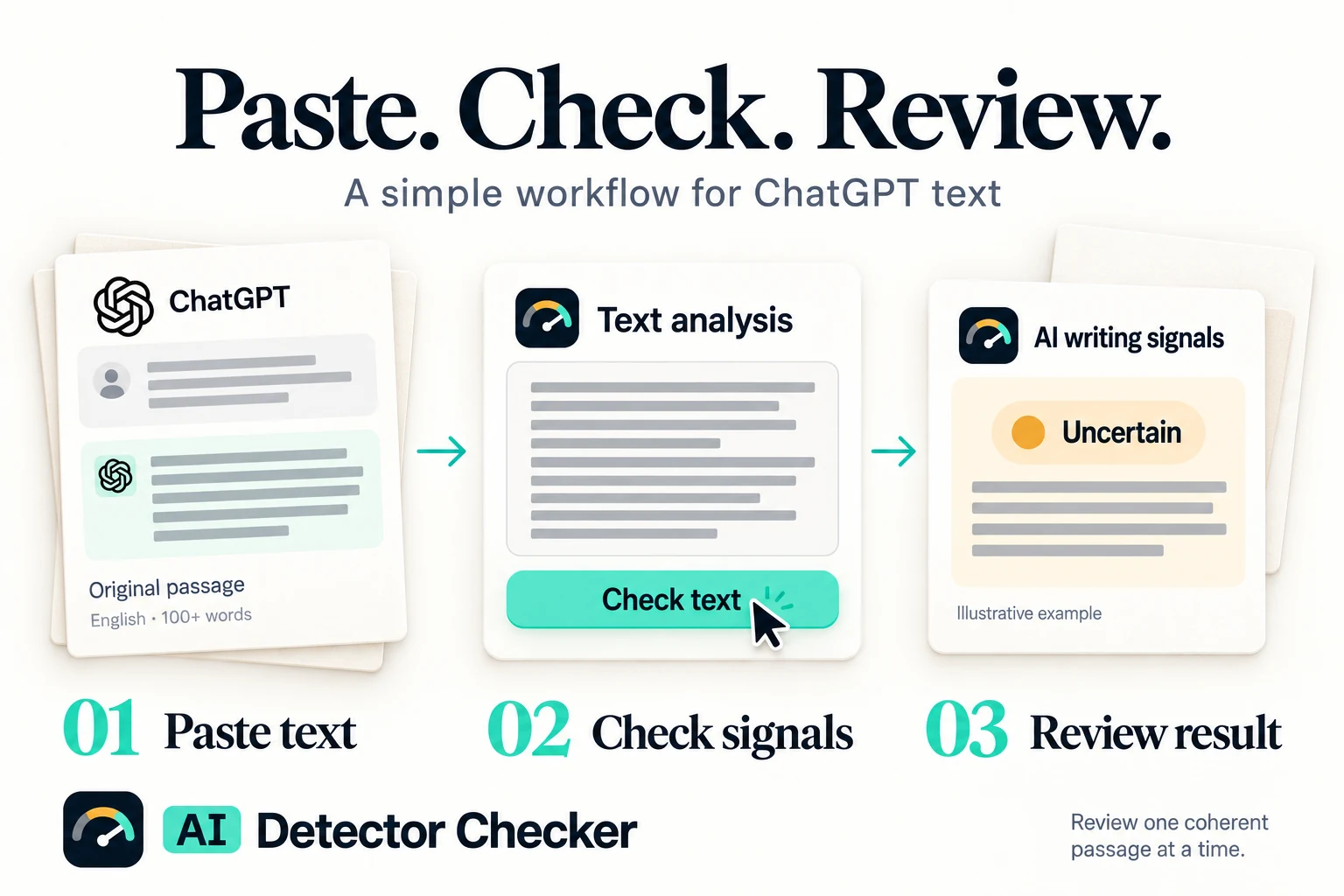
- Use the original passage. Keep an unchanged copy before reviewing or editing it.
- Choose a meaningful sample. Submit a complete paragraph or longer section from one document and one writer when possible.
- Remove sensitive information. Do not submit confidential, regulated, identity, medical, financial, or unpublished material.
- Run the check. Open the free AI detector, paste the text, and analyze it once before making changes.
- Read the full output. Take the score and band as one review signal; the score is an estimate of signal strength, not the chance that AI wrote the text.
- Add provenance. Compare drafts, sources, citations, revision history, known writing samples, disclosures, and the writer’s explanation.
Do not combine unrelated documents or multiple writers into one input. Mixed material can conceal important differences and makes the result harder to interpret.
How to Interpret a ChatGPT Detector Result
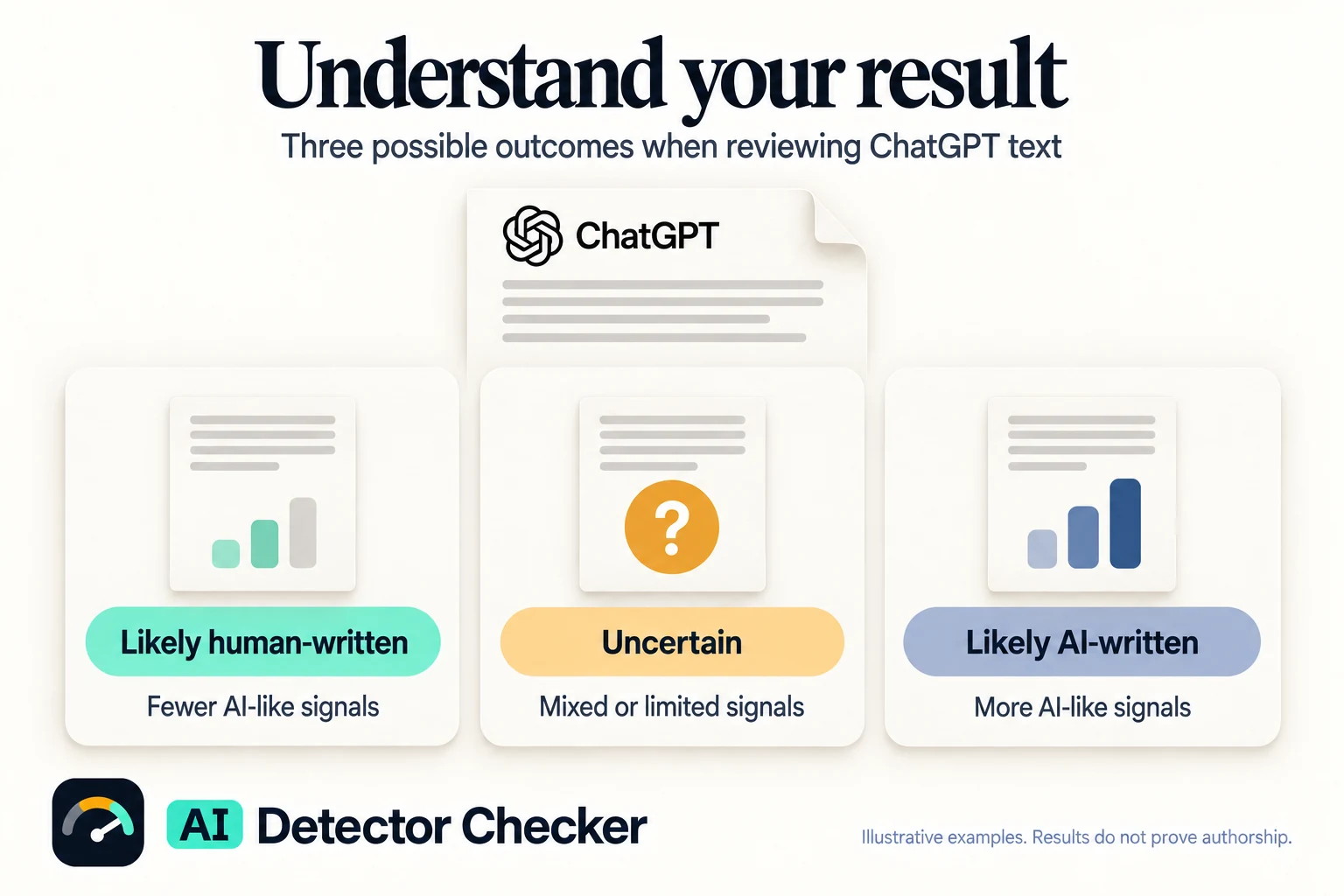
The result is a 0-100 AI-writing signal score with a stability range and one of three bands under AI Detector Checker’s current configuration. It does not answer “Who wrote this?” or “Which model was used?”
| Result band | Responsible interpretation | What it does not establish |
|---|---|---|
| Likely human-written | The text showed fewer of the patterns measured by the document classifier. | Human authorship or absence of ChatGPT assistance. |
| Uncertain | The available signal is mixed or insufficient for a clear outcome. | A hidden percentage split between human and AI. |
| Likely AI-written | The text showed more of the patterns associated with AI-like writing. | ChatGPT authorship, a specific GPT version, or misconduct. |
For the complete explanation of the score and bands, see how to interpret an AI detector result. If the text receives the Likely AI-written band, follow the steps in what to do if text is flagged as AI.
False Positives, Missed Detections, and Edited GPT Text
A false positive occurs when human writing receives the Likely AI-written band. A missed detection occurs when AI-generated writing receives the Likely human-written band. Both occur, and Uncertain outcomes also occur. That is why a single result should remain one review signal rather than a final verdict.
Human editing, paraphrasing, translation, and mixed human–AI drafting can change the result, and the direction and size of the change are not predictable. A Likely human-written result after editing does not prove human authorship, and a Likely AI-written result does not prove ChatGPT use. Review the full guidance on AI detector false positives and limitations.
When a ChatGPT Detector Is Useful
The safest use is low-stakes review: checking your own draft, identifying passages that deserve closer sourcing or editing, or supporting an editorial conversation. The result can help a reviewer decide where to look next; it cannot replace the review itself.
| Context | Useful next step | Do not infer |
|---|---|---|
| Self-review | Check specificity, sources, factual claims, and whether the final text reflects your intended voice. | That changing a detector result makes the writing better. |
| Editing and publishing | Review evidence, originality, attribution, usefulness, and accountable human edits. | That an AI-writing-signal label measures quality, plagiarism, or search performance. |
Do not use AI Detector Checker for academic, employment, disciplinary, legal, healthcare, credit, insurance, housing, immigration, or compliance decisions. Do not submit or analyze another person’s text without their knowledge and consent. Read the current model card and prohibited uses before using a result in any review process.
For low-stakes, consented self-review, browse AI detector guides by content type. For permitted and prohibited uses, read the current model card.
Can It Identify GPT-4, GPT-4o, or Another GPT Version?
No. AI Detector Checker does not identify a source model or version. The published evidence above concerns two dated historical API IDs only. It does not establish coverage for GPT-4o, another named version, a current ChatGPT model selector, or every future GPT release. A defensible version-specific claim would require a separate dated evaluation using exact model IDs, controlled generation settings, matched human texts, and the detector release tested.
Compare Other AI Model Guides
These guides explain model-qualified search use cases and evidence limits. They do not claim that writing style alone can identify the source model:
- Claude AI Detector guide
- Gemini AI Detector guide
- DeepSeek AI Detector guide
- Microsoft Copilot Detector guide
- Compare all AI model detector guides
Evidence and Sources
- AI Detector Checker benchmark, scope, limitations, and public files
- RAID paper
- RAID repository and historical generation mapping
- AI Detector Checker methodology and current model card
ChatGPT Detector FAQ
Is there a free ChatGPT detector?
AI Detector Checker provides a free AI-writing-signal check that you can use for text associated with ChatGPT. It cannot verify ChatGPT authorship or identify a GPT version. Open the free AI detector, submit a meaningful passage, and interpret the result with context.
Can AI Detector Checker prove that ChatGPT wrote a text?
No. AI Detector Checker measures general AI-writing signals. It cannot prove that ChatGPT, another AI system, or a human wrote the passage, and it does not have access to account, prompt, or document-history metadata.
Does it detect current ChatGPT models?
You can submit text associated with a current ChatGPT experience, but the result is a general AI-writing signal for the whole passage, never a verified model identification. The figures this site publishes come from one sealed test that covered two current OpenAI models and one unseen model lineage; earlier engines were benchmarked on small historical GPT samples and those numbers describe retired releases only.
Can it identify GPT-4, GPT-4o, or another GPT version?
No. AI Detector Checker cannot identify the GPT version that produced a passage. A model name in a page or query describes the suspected source, not a model-attribution capability.
Can human writing be flagged as ChatGPT-like?
Yes. Formal, technical, academic, legal, policy, templated, or heavily edited human writing can land in the Likely AI-written band. Context, drafts, sources, revision history, and human review are essential.
Can editing or translation change the result?
Yes. Editing, paraphrasing, translation, and combining human and AI text can change detector outputs in either direction. A changed result does not establish who wrote the passage or which system was used.
How much text should I check?
Use a coherent paragraph or longer passage when possible. Very short text contains fewer language patterns and is easier to misinterpret. More text provides more context, but it does not turn the result into proof.
Can I use the result for school, hiring, discipline, or another consequential decision?
No. Do not use AI Detector Checker for academic, employment, disciplinary, legal, healthcare, credit, insurance, housing, immigration, or compliance decisions. Do not analyze another person’s text without their knowledge and consent.