
Model guide · reviewed 5 September 2026
Claude AI Detector
The tool below is the same detector as on the homepage.
English · 100+ wordsengine v3
Paste text to check
V3 uses the same trained core as V2 with new length-based thresholds and a 0-100 display map. How it works →
What the evidence shows
No Claude AI Detector-specific figure exists: the sealed test covered two current OpenAI models and one unseen model lineage. Human text from unseen sources received a wrong AI signal about 2 in every 1,000 times at 150 words or more. The detector never identifies which model wrote a text; this guide describes writing patterns to review, not a measured detection rate. See the evidence page.
Important: The tool does not identify the source model. Model version, prompt, settings, language, task, and human editing can make outputs from different systems overlap substantially.
Looking for a Claude AI detector or Claude AI checker? AI Detector Checker can review a passage for general AI-like writing signals and return a 0-100 AI-writing signal score with a score stability range and one of three bands (Likely human-written, Uncertain, or Likely AI-written) for English text of at least 100 words. Use the result to decide what deserves a closer look—not to decide who wrote the text or which AI system may have been used.
Can AI Detector Checker tell whether Claude wrote a text?
Short answer: no. A detector can compare language patterns with patterns learned during training, but text alone usually does not contain a reliable label naming its author or model. Claude output can overlap with human writing and with output from other AI systems. Prompt instructions, model version, topic, length, translation, paraphrasing, and human editing can all change the result.
- It can: return a 0-100 AI-writing signal score with one of three bands — Likely human-written, Uncertain or Likely AI-written — for review.
- It can: tell you when a passage is too short to assess (fewer than 100 words).
- It cannot: confirm that Claude produced the passage.
- It cannot: distinguish Claude Sonnet, Opus, or Haiku from one another.
What Is a Claude AI Detector?
The phrase Claude AI detector commonly describes a tool used to check text that may have been generated or assisted by Claude. In practice, AI Detector Checker does not perform Claude authorship attribution. It evaluates general AI-writing signals, so the same workflow can be used for text associated with Claude, ChatGPT, Gemini, DeepSeek, Copilot, or an unknown source.
That distinction matters. A polished answer, a cautious tone, consistent sentence structure, or detailed reasoning may appear in AI-assisted writing, but those features can also appear in careful human writing. They are not unique Claude fingerprints. A responsible Claude detector therefore supports review; it does not replace evidence about how a document was created.
How to Check Text That May Have Been Written With Claude
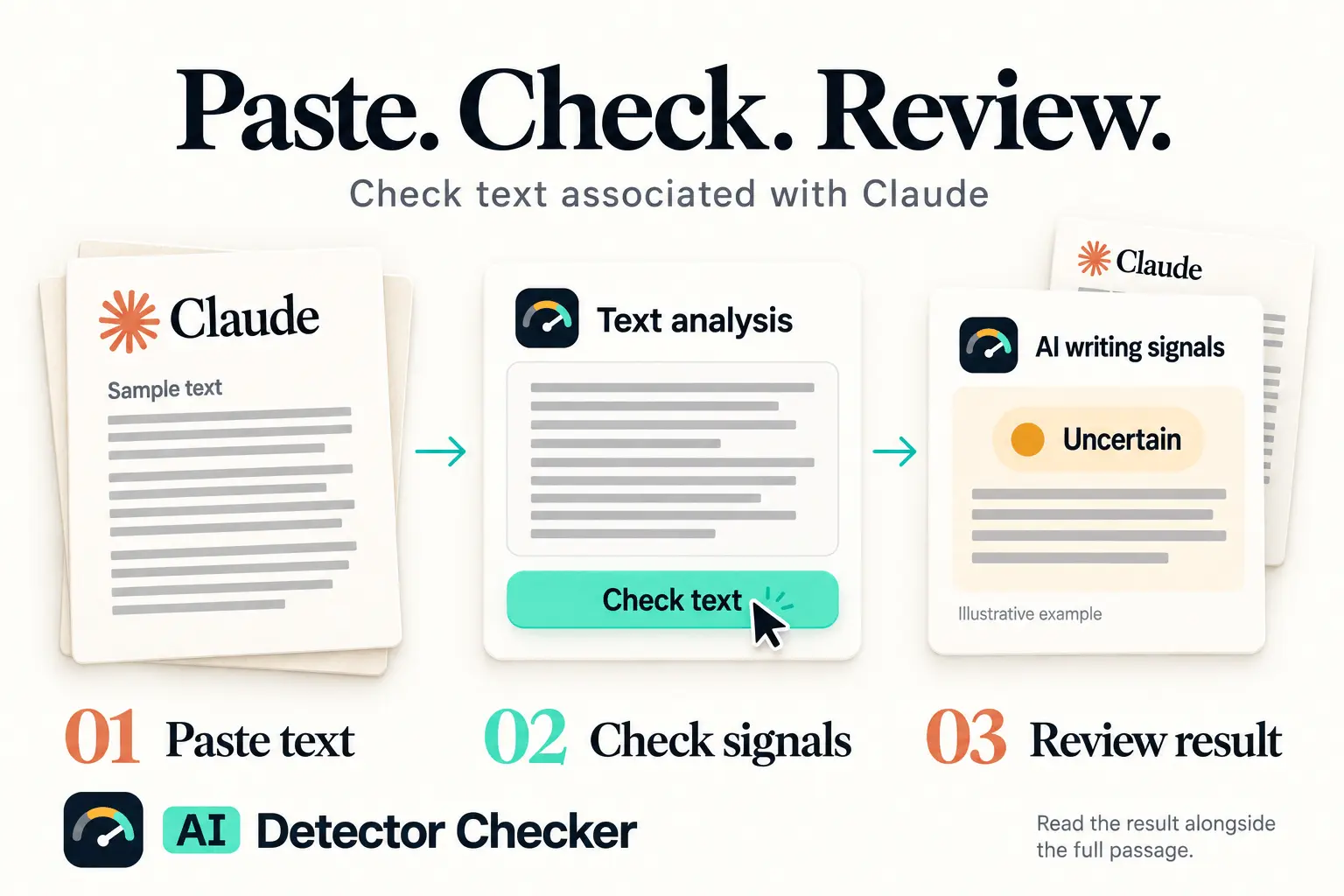
- Open the detector. Go to the free AI detector on the homepage.
- Paste a meaningful passage. Use a complete paragraph or longer excerpt when possible. A very short sentence gives the system less language behavior to review.
- Run the analysis. Keep the original wording for the first check; do not rewrite the passage merely to chase a different result.
- Read the full result. Take the label as one review signal and read the passage yourself.
- Add human context. Compare drafts, sources, revision history, known writing samples, and the author’s explanation before drawing a conclusion.
If you are checking several documents, review them separately rather than combining unrelated writers or topics into one input. Mixed material can hide meaningful differences between sections.
How to Interpret a Claude Detector Result
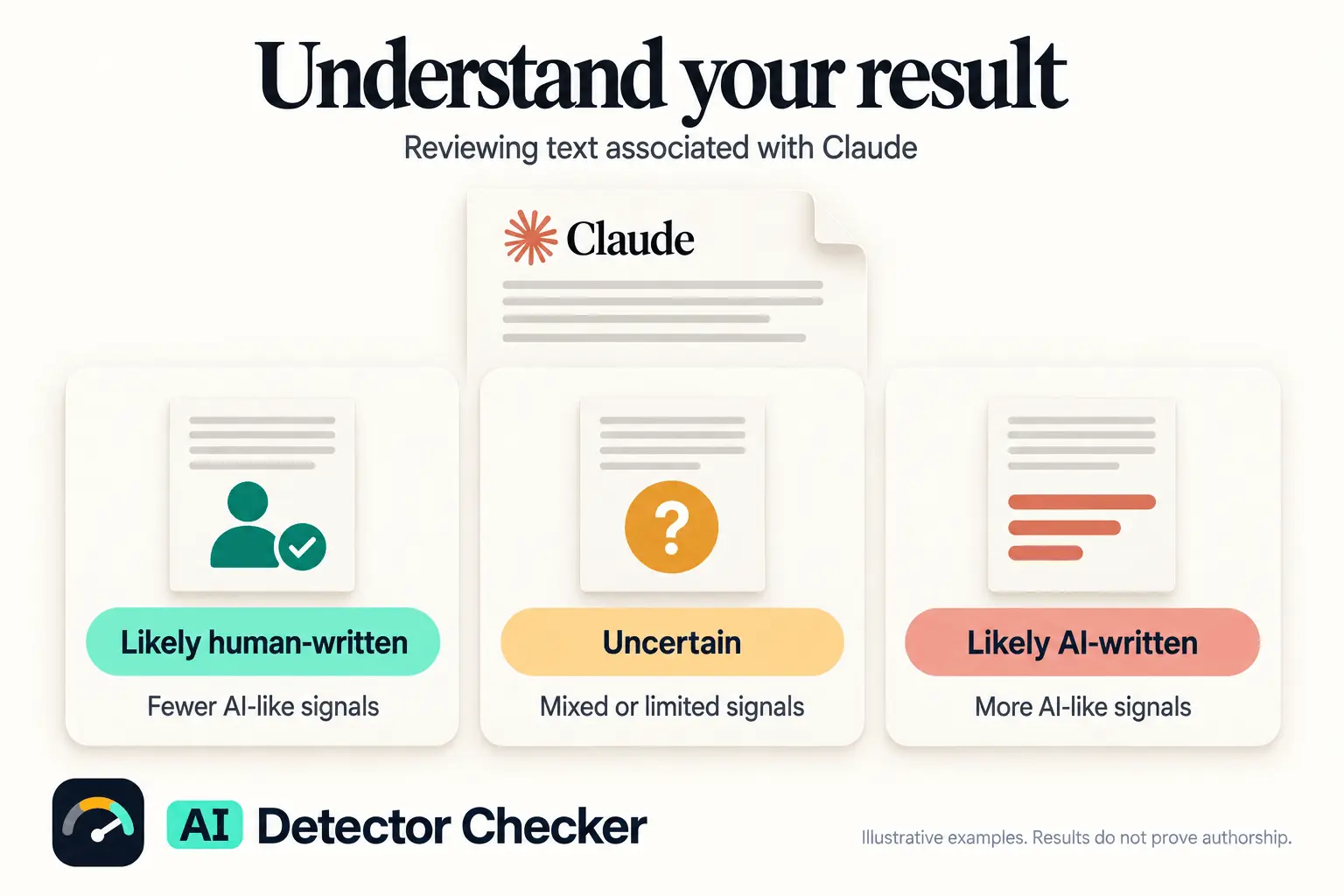
AI Detector Checker’s document-level classifier returns a 0-100 AI-writing signal score with a stability range and one of three bands. The score is not the chance that Claude wrote the passage and not a certainty figure.
| Result | Responsible interpretation | What it does not mean |
|---|---|---|
| Likely human-written | The passage showed fewer of the patterns the document classifier associates with AI-like text. | It does not prove the text is human or rule out Claude assistance. |
| Uncertain | The evidence was mixed or insufficient; treat the result as unresolved. | It is not a hidden yes/no verdict and should not be forced into one. |
| Likely AI-written | The passage showed more of the patterns the document classifier associates with AI-like text. | It does not prove Claude or any other model wrote the passage. |
Reading the passage
AI Detector Checker does not mark individual sentences. When a passage receives the Likely AI-written band, read the whole passage yourself; the label describes the passage as a whole, not any single sentence.
Uncertain results
An Uncertain band means the evidence was mixed or insufficient for a clear result. It is not accuracy or a certainty figure. For a complete explanation, see Understanding AI Detector Results.
Can It Detect Claude Sonnet, Opus, or Haiku?
You can submit text attributed to Claude Sonnet, Claude Opus, Claude Haiku, or another Claude model, but AI Detector Checker evaluates that text for general AI-writing signals. It cannot verify the source label, determine which Claude model produced the passage, or guarantee that Claude output will receive the Likely AI-written band.
Results may change across exact model IDs, release dates, system instructions, user prompts, sampling settings, tasks, languages, and editing workflows. For that reason, labels such as “Claude Sonnet detector” or “Claude Opus detector” should describe the text being reviewed—not a model-attribution capability.
Why Claude-Generated Text Can Be Hard to Identify
There is no single fixed Claude writing style. The same model can produce a terse email, a poem, a technical explanation, a table, or a long report. A human can also revise AI output until its rhythm and wording differ substantially from the original. Conversely, formal human writing can look highly regular without any AI involvement.
- Prompts change style: tone, audience, format, and constraints can reshape the output.
- Editing changes signals: additions, deletions, paraphrasing, and rearrangement can affect the result in either direction.
- Translation changes language patterns: a translated passage reflects choices made by both the source and translation process.
- Short text provides less evidence: brief inputs contain fewer patterns for a detector to evaluate.
- Genres overlap: academic, legal, policy, and professional writing can be structured and cautious even when fully human.
Claude Detection Evidence and Benchmark Limits
The published RAID-based benchmark is not a Claude benchmark. AI Detector Checker’s historical 880-text AI detector benchmark, run on a previous-generation detector (2026-08) and kept only in the evidence page’s history section, contains no documented Claude or Gemini outputs, and the current engine has published no Claude-specific evaluation. Its results must not be presented as a Claude-specific accuracy rate.
This page therefore does not claim a Claude detection accuracy percentage. A defensible model-specific claim would require a separate, dated evaluation using exact model IDs, clearly defined prompts and settings, matched human controls, transparent attrition, and the detector release tested.
Read the evaluation methodology for how AI Detector Checker is assessed, and use the benchmark only within its documented scope.
False Positives, Missed Detections, and Edited Text
A false positive occurs when human writing receives the Likely AI-written band. A missed detection occurs when AI-generated writing receives the Likely human-written band. Both outcomes are possible. Uncertain results are also expected and should remain unresolved rather than being counted automatically as human or AI.
Editing, paraphrasing, translation, and mixed human–AI workflows can change the result, and the direction and size of that change cannot be predicted. A Likely human-written result after editing does not prove the final passage is human, and a Likely AI-written result does not prove misconduct. Review AI detector limitations and false positives before using a result in a consequential setting.
Use a Claude AI Checker as One Part of a Review
| Context | Useful next step | Do not do this |
|---|---|---|
| Writing and editing | Use the result to identify passages that need sourcing, specificity, or closer editorial review. | Do not rewrite solely to manipulate a detector result. |
| Education | Review only your own draft, citations, sources, and revision notes to improve the writing. | Do not grade, accuse, discipline, admit, reject, or influence an academic decision. |
| Consented editorial review | Check sources, factual accuracy, disclosure rules, and document history. | Do not monitor, rank, discipline, hire, reject, or influence an employment decision. |
| Publishing and SEO | Evaluate originality, evidence, usefulness, and editorial accountability. | Do not assume an AI-writing-signal label measures quality or search performance. |
If a passage was flagged, follow the practical steps in What to Do If Your Text Is Flagged.
Compare Other AI Model Guides
Because AI Detector Checker does not identify the source model, the related pages below explain search-specific use cases and limitations rather than claiming unique model fingerprints:
- ChatGPT Detector guide
- Gemini AI Detector guide
- DeepSeek AI Detector guide
- Microsoft Copilot Detector guide
- View all AI model guides
Claude AI Detector FAQ
Is there a free Claude AI detector?
AI Detector Checker provides a free AI-writing-signal check that you can use for text associated with Claude. It does not verify Claude authorship or identify a source model. Open the free AI detector, paste a meaningful passage, and interpret the result with context.
Can AI Detector Checker prove that Claude wrote a text?
No. AI Detector Checker measures general AI-writing signals and cannot prove that Claude, another AI model, or a human wrote a passage. Use the result as a preliminary review signal only.
Can it detect Claude Sonnet, Opus, or Haiku?
It can analyze text attributed to those models for general AI-like signals, but it cannot distinguish Sonnet, Opus, or Haiku or confirm that any of them produced the text. Exact model version, prompt, settings, task, and editing can all affect the output.
How much text should I check?
Use a complete paragraph or longer passage when possible. Very short text contains fewer language patterns and is easier to misinterpret. More text can provide more context, but it does not turn the result into proof.
Can editing or translation change the result?
Yes. Editing, paraphrasing, translation, and combining human and AI writing can change detector outputs. The change may go in either direction, so a new result does not establish authorship.
Can human writing be flagged as AI-like?
Yes. Formal, academic, legal, policy, technical, or highly edited human writing can land in the Likely AI-written band. That is why context, drafts, sources, and human review are essential.
Does the published benchmark prove Claude detection accuracy?
No. The published RAID-based benchmark contains no documented Claude or Gemini outputs, so its results are not a Claude-specific accuracy rate. See the benchmark scope and results for the populations that were tested.
Should a school or employer act on the result alone?
No. Do not use AI Detector Checker to make, support, influence, or trigger any academic, admissions, employment, disciplinary, legal, healthcare, credit, insurance, housing, immigration, eligibility, or compliance decision about a person—even alongside other evidence.